Easter and its Ancient Pre-Christian Roots
Easter as we know it today has a long history spanning time and culture. There have been many connections that have been from the the festivals of Adonis, Osiris, and more. Dying and rising gods celebrated with festivals, bread, eggs and many other familiar symbols as we know it today during the festival of Easter.
Today we can also find bundles of wheatgrass upon altars of Christ as was the same for the god Adonis along with ancient songs… https://www.facebook.com/100063797647040/videos/2208414446244275
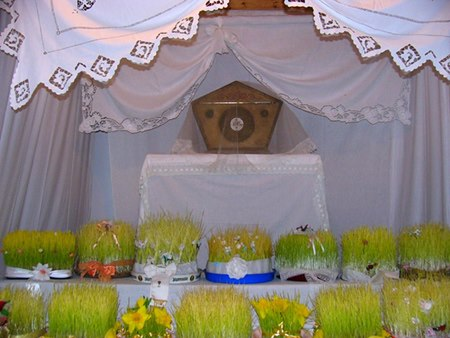
Ancient gods
Easter is a Lunar holiday in the Catholic calendar, thus its day changes from year to year. The Easter season truly begins at the start of Carnevale. An initiation into spring finalizing with the resurrection of Christ. Carnevale has been called many things which deserves its own post but among many names it has earned its title as the Festival of the Devil (Black Madonnas by Lucia Birnbaum). Here we see L’uomo Selvetico, the wild man of nature [Bacchus] take pleasure in its festivities. He is wild, untamed, representing the wildness of man. This eventually terminating on Easter, the resurrection of Christ, the anointed one, the enlightenment of humanity awakened. Thus symbolizing mans dominion over the untamed natural world itself, yet inseparable from it.
Other ancient ideas that pre-emanate Easter are also linked to Hermes, whos holds a rabbit and an egg. https://www.facebook.com/share/p/15Cu4Vjq3J/ (Associazione Tradizionale Pietas)
“Hermetic mysteries depicted in an Athenian star. The god Hermes (Mercury) holding an egg and a rabbit. These two symbols are connected to the Palingenesi, the regeneration of soul and spirit, which was practiced in the mysteries of spring renewal in the astrological month of Aries. These symbols of an eternal and immortal truth have survived the persecution and destruction of temples, so much that, even today, in the spring renewal (to which Christianity overlapped Easter), it is used to celebrate by eating eggs and rabbits (or even doves, like the egg and the rabbit, sacred symbols on Venus).”

Sacred Food
During holy week, many popular breads are created such as those with whole eggs in them such as La Sarcella. Symbolizing everlasting life of Christ. It was Mary Magdalene who in legend came to the Roman Emperor Tiberius and announced, “He is risen”. Tiberius mocked this statement and told her “no man has the power to rise from the dead”. In defense, Mary Magdalene pulled an egg from her clock which turned blood red in front of him, an Orphic symbol of eternal life that was very well known to the Etruscan, Greek, and Roman world.

Other such recipes include Il benedetto (U Benedìtte)
“tradition has it that the head of the family takes a small ritual, intending an olive branch (that of the previous Palm Sunday) in holy water and sprinkling the dishes. Hence the name of this traditional dish.“
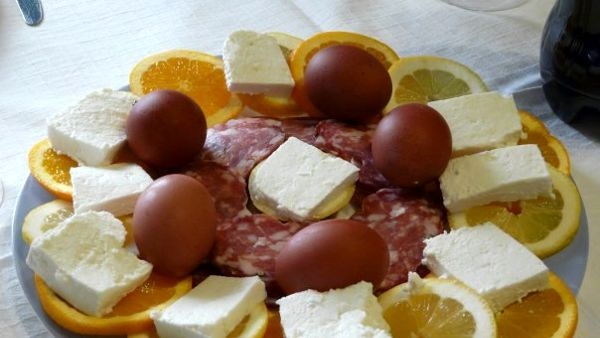
Other breads such as rosemary focaccia are made. These breads, like the breads that came before it, have a ancestral tradition in symbolizing the gods body via the bread. We see this explicitly within the Host at a Catholic mass, but the same was also true for the gods Bacchus and Osiris, whos bodies were symbolized via the bread.
“This was not just a simple food, but a talisman, enriched with the power of rosemary, capable of protecting from Satan, the biblical serpent, and other evil beings such as larvae, demons and striges that populated the underground kingdom. The rosemary bread thus became a symbol of devotion and spiritual protection, offering a deep connection with the Christian faith during Holy Week.” – Andrea Romanazzi https://centrostudiomisteritaliani.com/2024/03/18/magia-popolare-pasquale-la-focaccia-al-rosmarino-tra-folkore-e-magismo/
Spring Goddesses
But as much as we have spoken about the god, the goddess is also present. The rites of Demeter and Persephone never truly died, they were only transformed. Such are the rites of the “Mothers and Daughters” the Pupazze.
Easter in Bova, ancient rites of the Earth…
“The process of Latinization of ancient cults. It is evident that the Catholic religion, in its centuries-long process of Latinization, has overlapped with some pagan traditions. For example, the palm, together with the olive branch symbol of Palm Sunday, indicates the solar year because it puts forth one leaf per month.
This tree is connected to the rebirth rites of Egypt, where in the cult of the goddess Isis they used to depict her with a palm in her hand. The peoples of Asia Minor, on the other hand, used date palm leaves for funeral rituals. The Greeks, finally, presented the winners of the Olympic Games with a crown of olive and palm branches as a wish for good health and longevity.
Apuleius (170 AD) in the text The Golden Ass narrates the initiatory birth of Lucius before the simulacrum of Isis dressed in twelve veils and a crown of palm leaves. Apuleius himself alludes to the symbol of the palm, which in the processions of the mystic figures representing the Gods, they would shake a palm in guiding the souls.
And again, in the Roman Catholic tradition, the palm of martyrdom is the symbol of Christianity. Many Saints, in fact, are depicted with the palm branch as a symbol of beauty, fertility, martyrdom, ancestry, and emblem of victory.”

There is also the Calabrian tradition of Corajisima which counts the weeks of Holy Week. Again, we come back to Persephone, Corajisima, the widow of the King of Carnical. Holder of the thread of life. There are 7 weekly incarnations of her. She sits atop an orange with 7 feathers, usually the 1 of 6 is colored differently.
- 1. Anna
- 2. Susanna
- 3. Rebecca
- 4. Diana
- 5. Lazzara
- 6. Parma
- 7. Santa
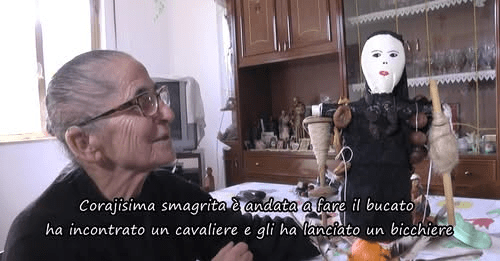
Lent in Italy – Corajisima, A Calabrian Tradition
Queremma – https://www.facebook.com/reel/1112508903518429
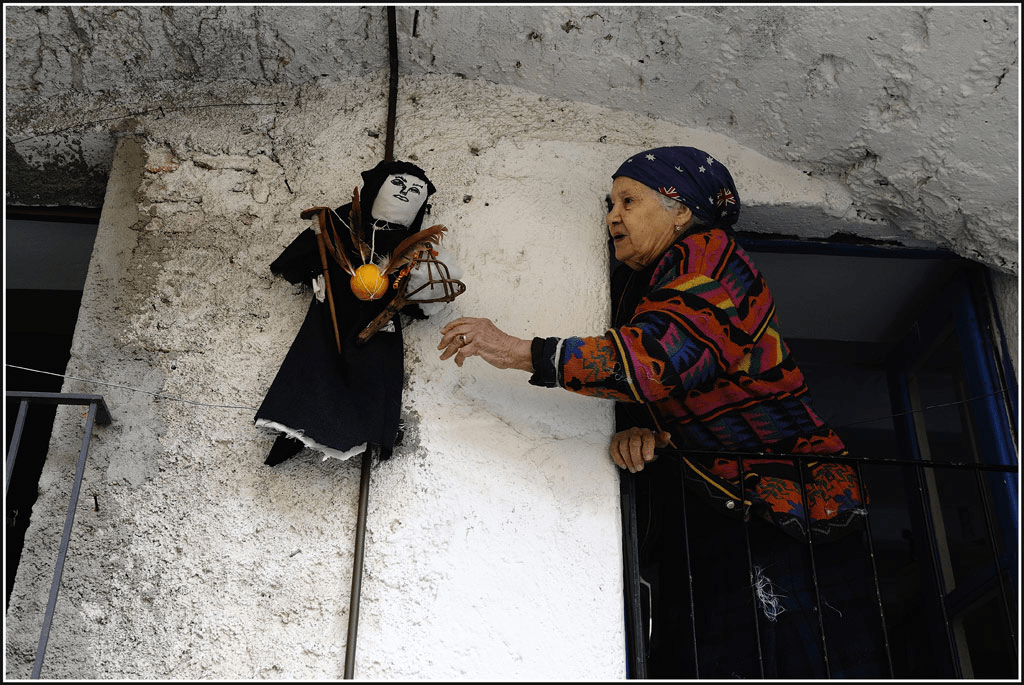
A Very Ancient Holiday of Resurrection
Pasqua is also a lunar holiday which is why the day shifts every year. March was also the the beginning of the year for the ancient Romans, leading to April, the month of Venus. The egg, the symbol of resurrection is an ancient Orphic symbol of eternal life. Its red color symbolized the life, blood, and vitality of eternal life from Adonis, to Dionysus, to Christ. Sometimes small offering of barley or wheat grass are given at the feet of Christ during this time. This is another ancient offering as was done for Adonis.
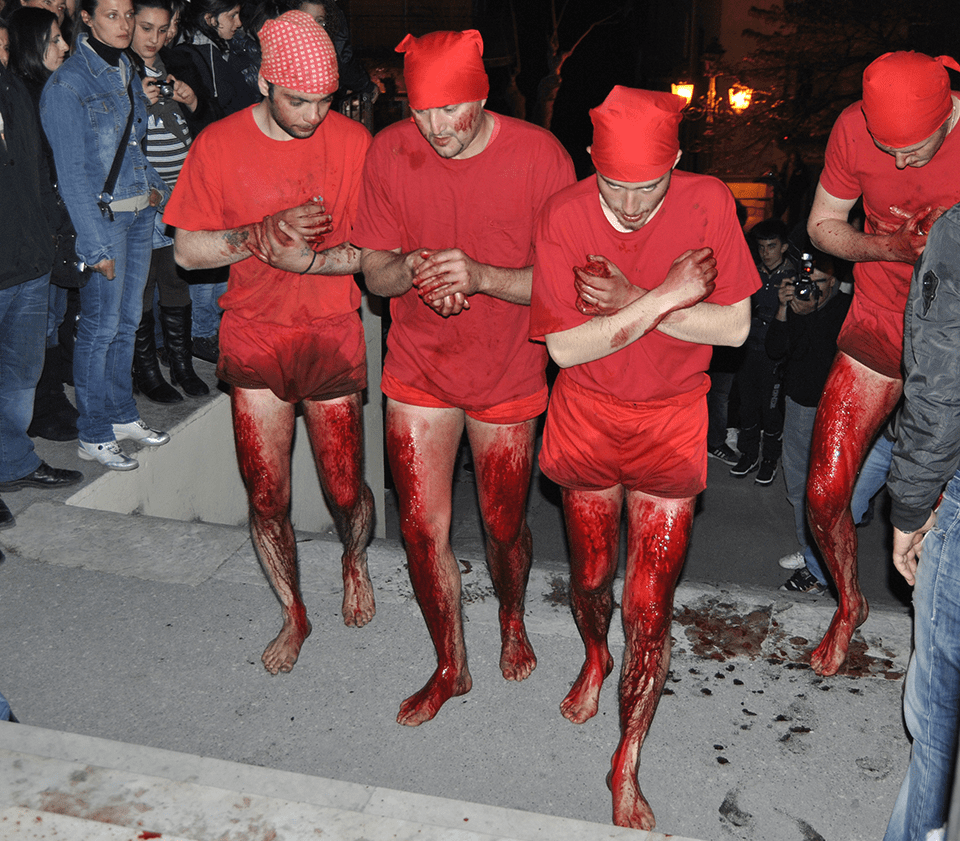
This is a video of the Battenti, an ancient blood ritual, only performed by men. I am not exactly sure of its origins, but flaggellation rituals and blood letting are well documented rites for ancient gods all around the world such as Baal of the Levant.
“Quello dei Battenti di Verbicaro è un antico rito molto conosciuto e che si svolge nell’ambito dei cerimoniali previsti della Settimana Santa.”
“The Battenti di Verbicaro is a very well-known ancient rite that takes place as part of the ceremonies planned for Holy Week.”
Sicilian Pasqua Ritual
To end this post, I’d like to share a beautiful Sicilian ritual for a home blessing for Pasqua, courtesy of our friend on the Benedicaria page.
Also, I would like to add that besides this ritual, it was customary growing up that the walls of the home were hit with a rolling pin on Easter, chanting prayers to drive away spirits from the home.
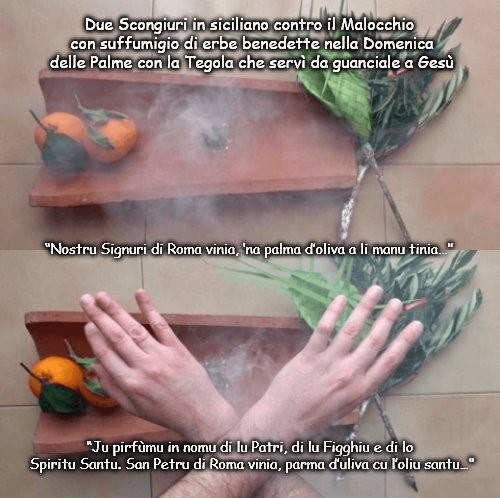
Two Scongiuri in Sicilian against Malocchio with enough blessed herbs on Palm Sunday with the Tegola that served as a guanciale to Jesus
The ritual practice for these two Scongiuri against the Malocchio is preceded by a “pirfùmu”, a suffumigio that consists of putting on a cooked pan (the cup, or curved tegola, locally called “canal”) a bunch of herbs,
i.e. orange (bitter) leaves, rosemary leaves, palm pieces and blessed olive leaves on Palm Sunday. You put lit coals on the herbs, and as soon as they start burning and the smoke is lifted you recite the Creed.
On the plate – believed to bring calm and rest because it served as a guanciale to Jesus – (but also a pottery container or in extremis any burning incense is fine) – the patient has to keep his hands in “crosses and nuts”, that is, in crosses (crossed) on the plate, and to play one of the two Scongiuri in Sicilian against Malocchio:
The first Scongiuro comes from Casalvecchio Siculo (Messina) and plays:
“Nostru Signuri di Roma vinia, In the olive palm and li manu tinia, above the altar the blessing, scippava l’occhi a cu mali facia: cu tri pani e cu tri pisci Nostru Signuri m’abbunnisci.”
Translation: “Our Lord from Rome came, an olive palm in his hands, on the altar he blessed her, May those who did evil were looking in the eyes: with three loaves and three fish Our Lord gives me abundance. ”
The second Scongiuro comes from Calatabiano (Catania) and plays:
“Ju pirfùmu in nomu di lu Patri, di lu Figghiu e di lo Spiritu Santu. St Peter of Rome was coming, olive parma with holy oil a li manu purtava e lu Signuri cu Maria Santa lu binidicia: Out malocchi, out escape, booklet , bill ! Cross away, cross away, leva l’occhiu chi mali facia! Duos will come, tri lu difinneru: lu Patri, lu Figghiu e lu Spiritu Santu; and so it shall be and the Holy Trinity.”
Translation: “I perfume in the name of the Father, of the Son and of the Holy Spirit. St Peter from Rome was coming , olive palm with holy oil in his hands he carried and the Lord with Holy Mary was blessing him: out evil eye, out stomping, tie (witch) bill! Cross over, cross over May the evil doers keep an eye on them! Two (evil eyes) ruined him (hurt him), three defend him: The Father, The Son and The Holy Spirit; and so it shall be for the Holy Trinity. ”
Bibliography
- – “Proverbi, motti e scongiuri”, di Giuseppe Pitrè
- – “Gli Scongiuri del popolo siciliano”, di Giuseppe Pitrè
- – “Scongiuri del popolo siciliano”, di Giuseppe Bonomo
https://www.facebook.com/share/p/1RGYi6nmg1/
 Salvatore Guglielmo