The Day of the Dead: An Italian Tradition of Honoring Ancestors
All cultures have a unique way of honoring the dead. From flowers, to songs, special foods and prayers. In many cultures influenced by Catholicism, the days reserved for honoring the dead occur between October 31st (Halloween) more so with Northern Europe and America, November 1st (All Saints Day), and November 2nd (All Souls Day).
In this article I will discuss traditions of the dead that are not necessarily tied to this time of the year but are reserved for the dead, past and present. The Carnevale, in festival spirit, is the equivalent of the American Halloween albeit taking place in Spring. This is a harvest festival, sometimes called “the festival of the Devil” by Lucia Birnbaum in her book Black Madonnas. During this time many folk characters such as Pulcinella (Napoli), a true psychopomp, parade the festival in his mask dressed in red, black and white.
“Some traditions also include lighting a red candle or lumino on the window sills at sunset and laying out a table of food for deceased relatives who will come to visit.” In America, this tradition also exists but the candles are white.
https://en.wikipedia.org/wiki/Day_of_the_Dead
Frutta Martorana (Marzipan) is a common sweet pastry like food of the dead. It is very common cross-culturally that sweet foods and/or candy is preferred by the dead. https://www.visititaly.eu/food-and-flavours/the-frutta-martorana-the-typical-sicilian-dessert-for-all-souls–day
“The feast is celebrated on November the 2nd and dates back to the X century. The legend said that, in the past, dead people visited their relatives and left a gift for the children during the night before.”
In accordance with Southern Italian tradition, the best days of the week in honoring the dead are Mondays and Fridays which were recorded by the late Giuseppe Pitre in his Usi e costumi credenze e pregiudizi del popolo siciliano / raccolti e descritti da Giuseppe Pitrè V.4. Monday (lunedì) is the day of the Moon and Friday (venerdì) is the day of Venus, reflected in the name of the week. Friday is also a very auspicious day to not offend others as it will produce il malocchio (Evil Eye) more than other days and will last through the weekend. It is also the only day of the week that the “Donni di Fora” (Donne di fuora) do not dance.
“Relatives and strangers alike celebrate the giorno dei morti in these crowded, ancient tombs.”
https://www.nationalgeographic.com/travel/article/exhumation-ceremony-day-dead-history-family
Family Traditions Brought to America
It was a common thing to hear as a child at a funeral that the “Boat Man” or the “Skeleton Man” is coming. Family would place coins over the eyes of the deceased and special prayers were said by the matriarchs of the family over the dead in their coffin. Family, especially the women, throwing themselves over the coffin, wailing to the dead. Grievances announced, fights, tears, all a mixture of the sacred and profane, a blend of the old Pagan culture intricately woven with the modern Catholic faith. When the Catholic priest was coming, anxious whispers would sound around the matriarchs to hurry and finish the segneture (gestures) and prayers that were more like incantations to help the dead. The coins removed and placed in the deceased mouth. Nonno would joke that they need more than two coins now for the Skeleton Man as economic inflation was rising to get you across the waters! There is another tradition that was spoken of sometimes referred to as “U’cammanu” or the commanding where a skull or head shaped object houses a spirit, used to communicate various matters.
Naccarata
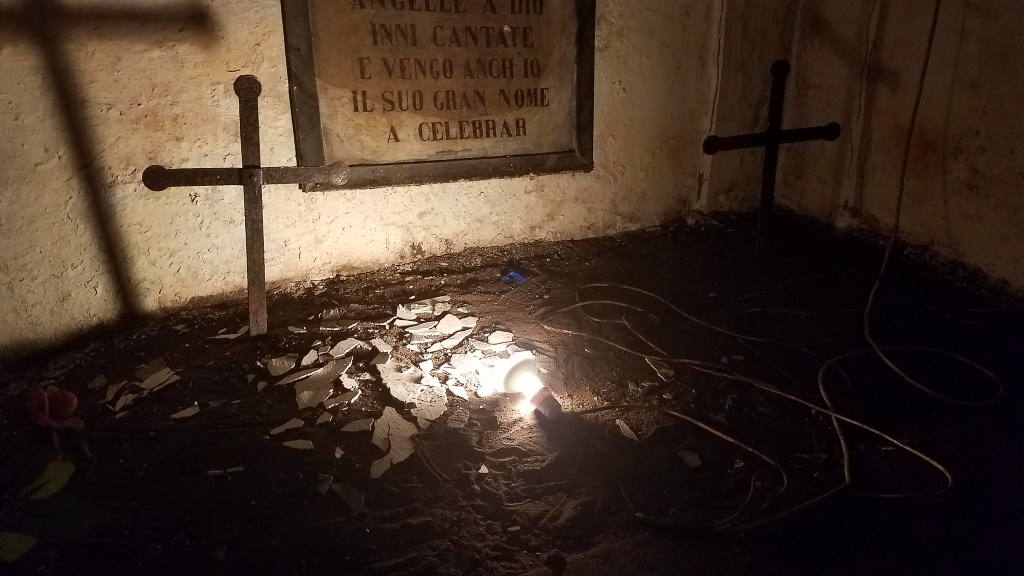
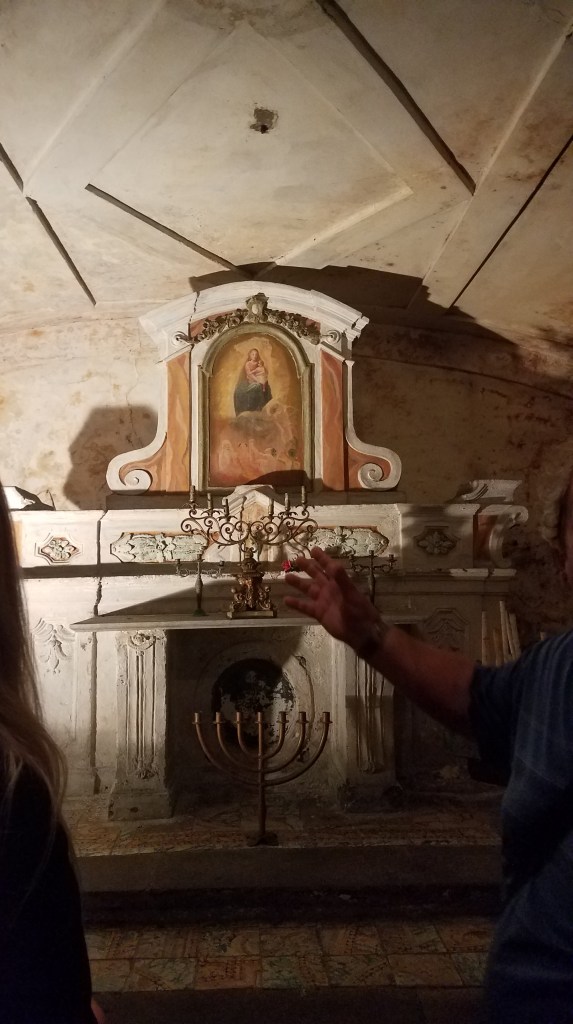
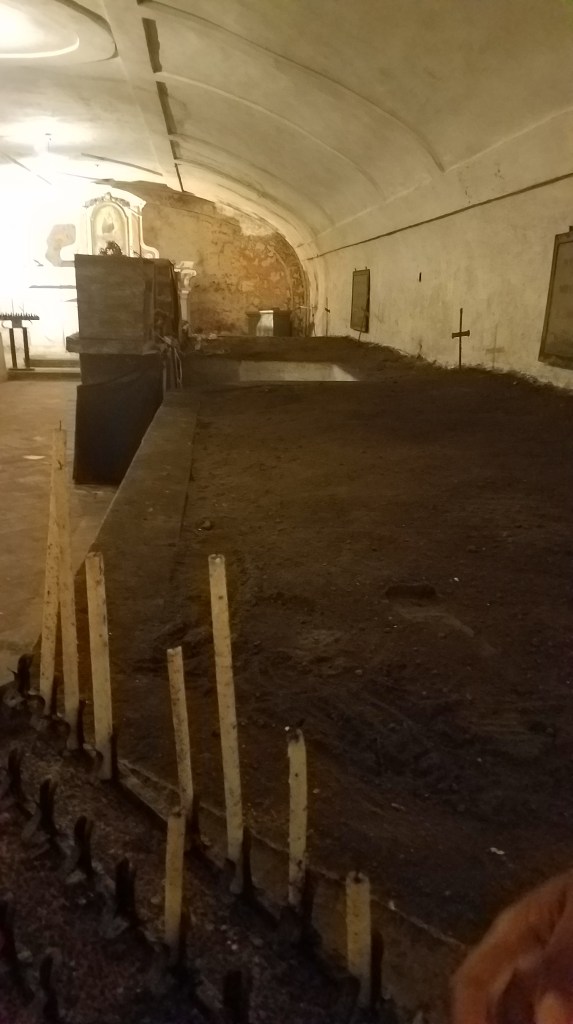
These beliefs are very ancient and belong to a larger tradition of death rituals called “Naccarata”, the funeral songs. It was common in the Middle Ages in Italy to believe in La Madonna as the guide of souls on her underworld boat, guiding the dead to their final resting place. It was a pleasure to see this preserved in stone at the Chiesa of La Madonna Delle Neve. As I was told by archeologist Armando Mei, this chamber is shaped like an upside-down boat, which reflects the overlapping of worlds and the voyage to the afterlife.
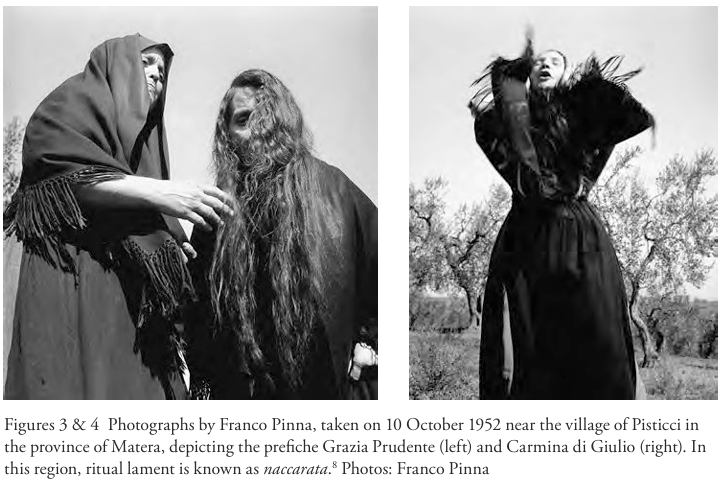
Forgacs 2014:147).
Performing and Re-enacting Southern Italian Lament on JSTOR: Performing and Re-enacting Southern Italian Lament by Michaela Schäuble
Zeitschrift für Ethnologie (ZfE) / Journal of Social and Cultural Anthropology (JSCA)Bd. 146, H. 1/2, Special Issue (continued from Vol. 145.2): Rethinking the Mediterranean (2021), pp. 53-74 (22 pages) Published By: Dietrich Reimer Verlag GmbH
Flowers for the Dead
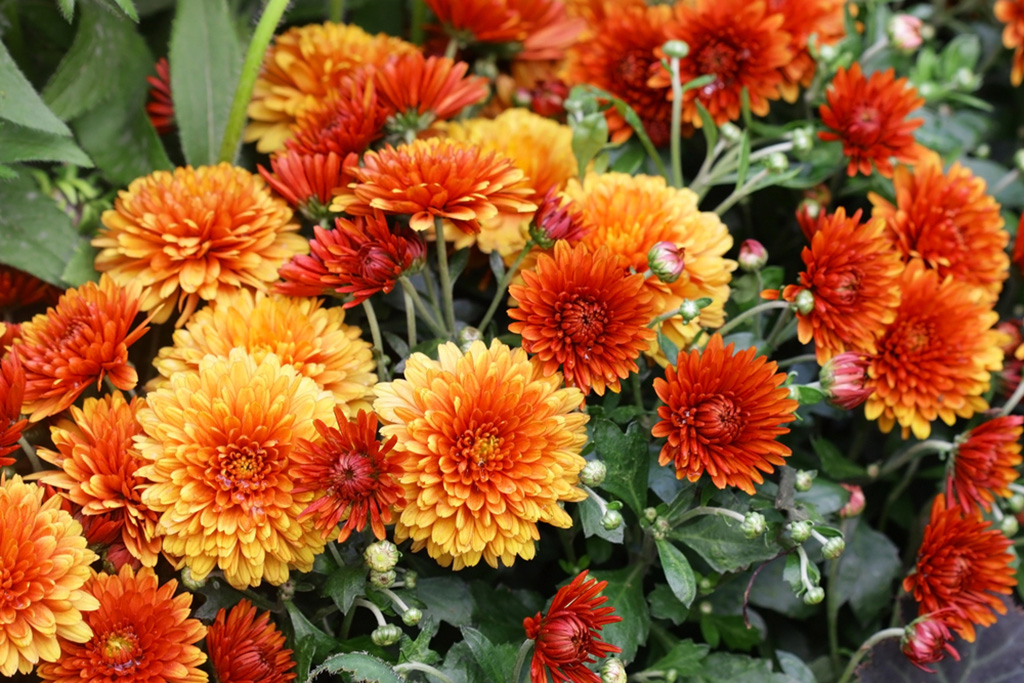
Like in Mexican culture where people honor the dead with with the native marigold flower, so too Italians honor the dead with their native crisantemo (Chrysanthemum [Mum]) flower.
Legend of the crisantemo – https://www.steflor.it/consigli/consiglio/la-leggenda-del-crisantemo
The Ancestors: They who appear in red, black, and white
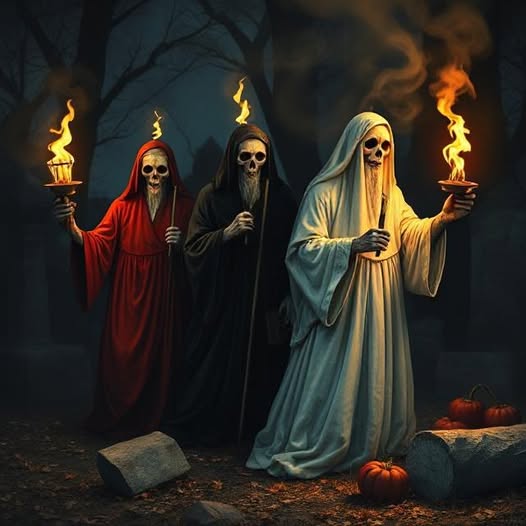
The Dead (always plural) are the souls of our dearest relatives, who once a year, on the night between November 1st and 2nd, come out of their graves and come to cheer up our little children, leaving them all the most beautiful things according to the tastes and desires of children .
The Dead leave the cemeteries and enter the city. Since in the past the cemeteries were mostly within the Capuchin convents, the Dead usually leave from those convents. In Cianciana however they leave the convent of S. Antonino de ‘ Riformati, cross the square and arrive at Calvary ; there, after saying a prayer to the Crucifix, they go down the Via del Carmelo. It is precisely during the passage that they leave their gifts to the good children.
On the journey they follow this order : first go those who died a natural death, then those who were executed, then the unfortunate, that is, those who die through misfortune unknowingly, those who die suddenly, that is, suddenly, and so on.
In Modica the Dead rise as usual, on the night of their feast, and precisely when the cock crows for the first time; they emerge from the tombs in groups and line up in pairs as in processions and walk slowly.
- The first groups are dressed in white and are the souls of those who died in God ‘s grace ;
- The second groups are dressed in black, and are the souls of the damned;
- The last are dressed in red, and are the souls of the slain .
Each of the dead has a brazier (a cunculina) on their head; but the procession cannot go beyond the first cross it encounters, because at the sight of the cross the Dead are forced to retreat .
Customs, habits, beliefs and prejudices of the Sicilian people / collected and described by Giuseppe Pitrè V.4
“Le monde enchanté by Balthasar Bekker, published in the second half of the seventeenth century, proposes one of the most evocative interpretations of the cult of the dead, which is useful for us to understand the Sicilian cult of the dead. According to the Dutch theologian, men think that there is a higher deity, God, and of the lower deities, the demons, sous-dieu, mediators between God, and the men, who have a part in the administration of the universe.
The cult of the souls of the dead would therefore be a remnant of the Greek cult of spirits and the Demiurge of which Plato speaks.
This cult for the dead is a deeply felt devotion in Sicily, where people learn to respect them together with the first rudiments of the Christian doctrine inculcated by the mother or the women of the family. This involves for the Church the difficult problem of strengthening faith in the afterlife, without allowing the worship of the souls of the dead in the pagan and folkloric forms practiced by the population.”
Pg. 413
— Inquisitors, necromancers and witches in modern Sicily (1500-1782) by Maria Sofia Messana
La Fucacoste: The Night of Fires
“On the occasion of the celebration of the Dead – also known as the Feast of the Dead – in Orsara di Puglia, a town in Daunia, there is a traditional festival with ancient origins: “Fucacoste e Cocce priatorje” (Bonfires and Heads of Purgatory). Dozens of large bonfires are lit in the streets of the town, and hundreds of pumpkins, carved by the citizens of Orsara, in human likeness, are displayed, illuminated inside them by a lantern. The holiday celebrates the souls of the departed who, according to popular tradition, on this night visit their relatives and return to what were their homes in life. It is therefore the task of the bonfires to warm these souls in their nocturnal wanderings and of the pumpkins to illuminate the houses where they lived.
The protagonist of the nightly bonfires is the broom…”
Howling/Wailing to the dead
La Accabadora – The Woman of Death | Sardinian Folklore
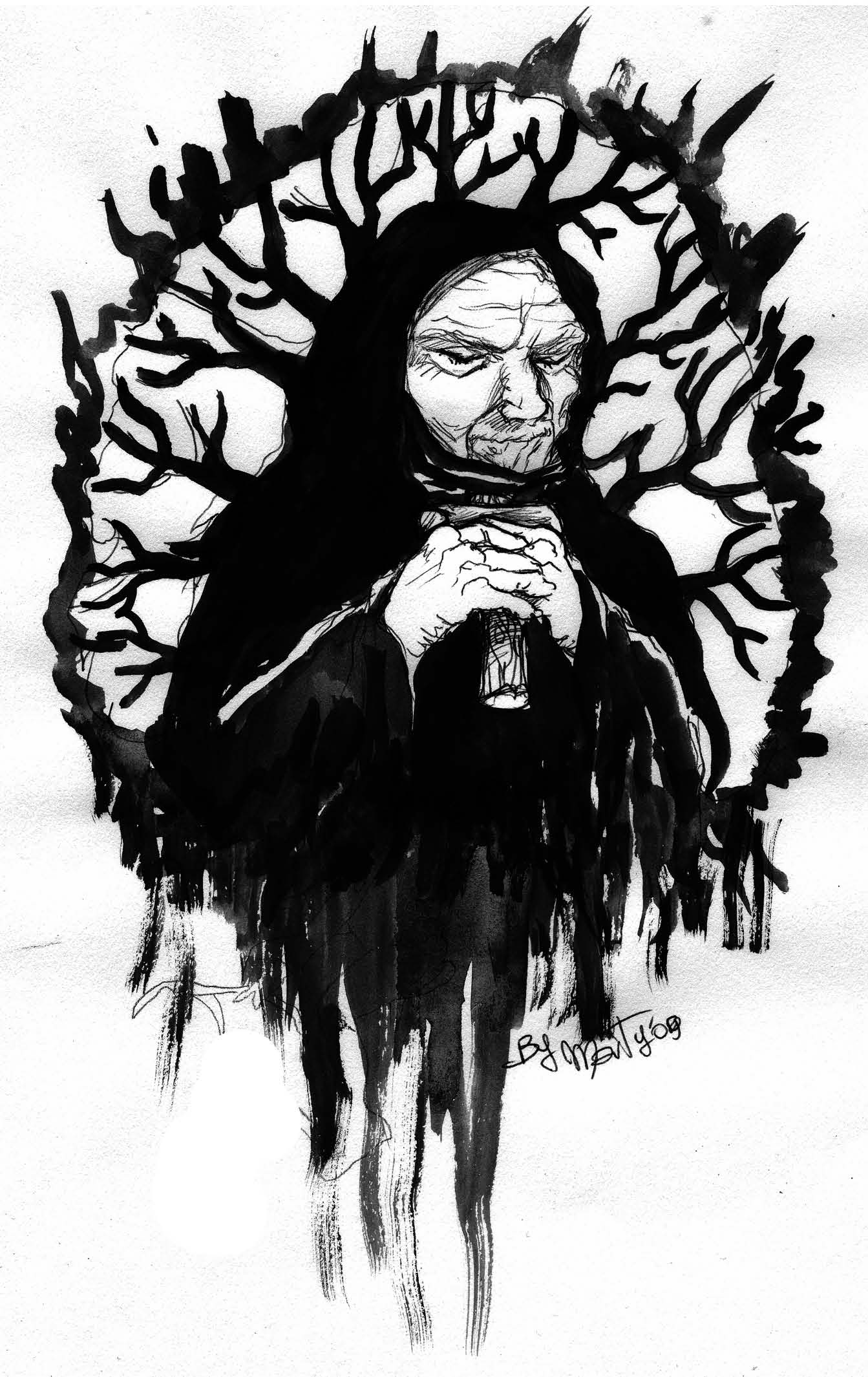
“La Accabadora is a middle-aged woman dressed in black with a long shawl covering her head. Her job, as appointed by the community, was to apply euthanasia to the old and infirm using a cudgel (a short thick stick used as a weapon).”
Neapolitan Cult of the Dead: Anima Pezzentelle
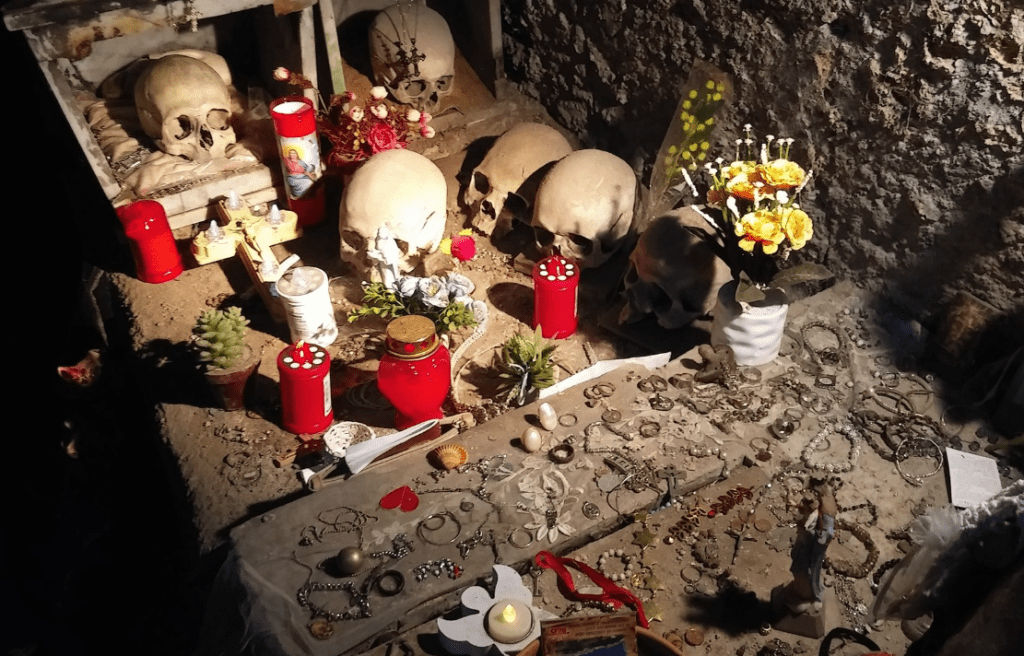
The three guardians of the Cimitero Delle Fontanelle“Lucia are the “Virgin Bride” (who rests in the hypogeum at Santa Maria del Purgatorio ad Arco), “Donna Concetta,” and “Il Capitano” (who appears as a Cabinieri) (both at the Fontanelle Cemetery) who are treated like the relics of saints, in that they are considered community property and cannot be adopted by an individual. http://www.allthesaintsyoushouldknow.com/new-gallery-72
“Some of these “capuzzelle” were eventually wrapped up in even more mysterious tales. For example, donna Concetta’s skull, also called “‘a capa che suda”, the sweating skull, (in the picture above) became famous because, unlike other skulls, hers is always polished and wet. For this reason, it was believed that the skull was soaked in sweat from her suffering in purgatory. Another famous skull is that of the Capitano (the captain) around which many different stories circulate. According to the most popular one, a young soon-to-be bride was very devoted to the Captain and frequently went to the cemetery to pray for his soul. Her fiancé was jealous of the attention she paid to the skull and once went to pray with her. However, he took a cane with him and poked the poor skull with it (thus the strange blackness of the skull’s right eye socket). The girl’s fiancé scoffed at him and, mockingly, invited the Captain to their wedding.The day of the wedding, a man dressed like a carabiniere (a member of the Italian paramilitary police) appeared among the guests. The groom then asked who he was and the man replied that he had invited him to the wedding when he blinded his eye with the cane. The man showed** his real face** and instantly the two spouses and all other guests **died **on the spot.”
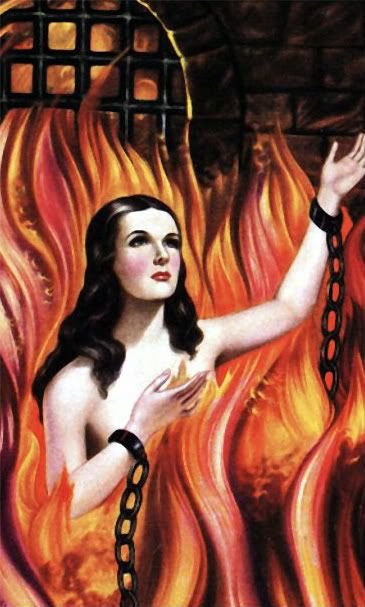
The Anima Sola is common throughout much of the Catholic world, though is perhaps strongest in Naples, where it is referred to as “the cult of the souls in Purgatory.”
https://en.wikipedia.org/wiki/Anima_Sola
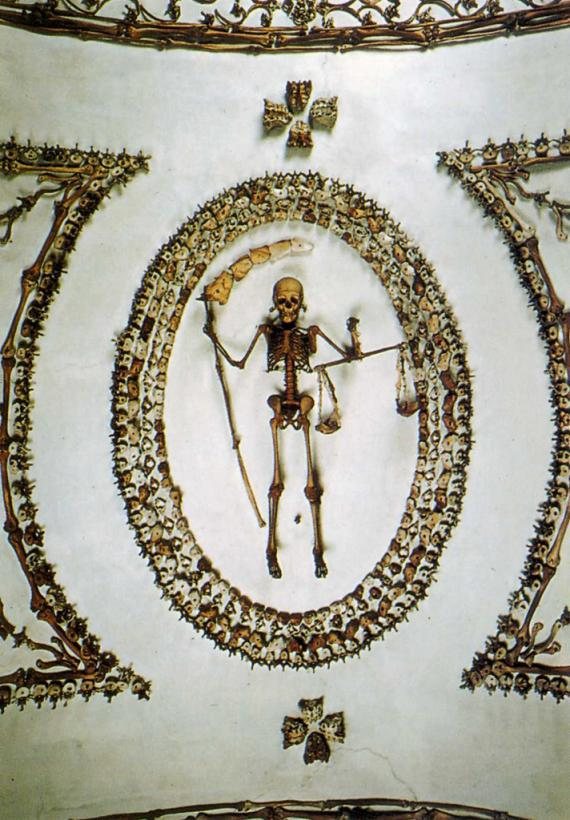
Church of Santa Maria dell’Orazione e Morte
- https://fatamorganajournal.blogspot.com/2013/04/santa-morte-holy-death-in-eurpoe.html?fbclid=IwY2xjawNsfCBleHRuA2FlbQIxMABicmlkETFFU2ViY0w3V09Fb21kZjJ3AR5EOjiyx-Ai9hLSLiUFEX4zhowtdTQl17RmYj22VQ5rgEFPrGajISO7ruXVUQ_aem_uEINYbudLfTEru8UzwgmBQ
- https://www.atlasobscura.com/places/santa-maria-dell-orazione-e-morte?fbclid=IwY2xjawNsfEBleHRuA2FlbQIxMABicmlkETFFU2ViY0w3V09Fb21kZjJ3AR5YJwyY-CptYyXx8uCLrovovkN9vFcsUI04YyN-KjK8d2tssyhJ5ZeP1qn0Mw_aem_AJou9gNdLJS286RNp9Aoag
- https://wildhunt.org/2017/11/column-la-santa-muerte-the-growing-veneration-of-holy-death-in-paganism.html?fbclid=IwY2xjawNsfExleHRuA2FlbQIxMABicmlkETFFU2ViY0w3V09Fb21kZjJ3AR74xvlIKX4fD8M4jclZ8b6N6rOSRoEQK0wvxtAN99h3CkRMDBhMcyPmydKEKQ_aem_HBbzgzvsPmbozJEqPC933g
- https://www.jesterbear.com/Aradia/Santa_Morte.html
Rosemary (Rosmarino) by Giuseppe Pitre
A Funeral Plant
Rosemary (Rosmarinus officinalis, L.) is considered the ultimate funeral plant. A Sicilian proverb states:
“There are many herbs in the garden,
But rosemary is for the dead.”
It is burned to disinfect places. During the plague of 1575-76 in Palermo, the poor used rosemary, laurel, and cypress fumigations to purify their homes.
(Note that the Donni di Fora are also ancestors that have reached a special status. A popular formula for them is to burn Incense, Rosemary, Bay Laurel, and an herb called Mancavi/Mancivi together. Coming from the verb “mancare”, which means “to lack” or “to be missing, this herb is most likely Mugwort but the identity of it is meant to be hidden. This together with the prayer; “Ti salutu re di lu Suli. Ti salutu re di la Luna. Ti salutu stidda ‘ndiana. Beni aspettu ‘ntra sìmana”)
Sacred to Fairies
Rosemary is sacred to fairies, who eat it eagerly. Enchanted princesses, when transformed into serpents, hide safely in rosemary bushes, and no one dares to harm them. If a serpent, while being chased, finds refuge in a rosemary bush, simply touching it ensures its safety. All snakes are killed—except those dwelling in rosemary bushes or near fountains (Acireale).
A Folk Tale: The Enchanted Rosemary
A queen, unable to conceive, once walked through her palace garden and came across a lush rosemary plant. She lamented her barrenness compared to the plant’s abundant growth. Soon after, she became pregnant and gave birth—to a rosemary plant. She cared for it dearly, watering it four times a day with her own milk.
Years later, a visiting nephew—who was the King of Spain—stole the plant and transplanted it in his garden. He became obsessed with it and watered it daily with goat’s milk. One day, as he played a flute, a stunningly beautiful girl emerged from the rosemary. Mesmerized, he continued playing whenever he wished to see her, and the two fell deeply in love.
When war called the king away, he entrusted the rosemary to his gardener, instructing him to protect it with his life. However, the king’s jealous sisters found the flute and played it. When the girl appeared, they beat her mercilessly. She vanished, and the rosemary plant began to wither.
Fearing the king’s wrath, the gardener fled. One night, while hiding in a tree, he overheard a conversation between a dragon and a dragoness beneath him. They revealed that the only way to revive the plant was to anoint it with their fat. Without hesitation, the gardener killed them and used their fat on the rosemary, bringing it back to life.
When the King of Spain returned victorious, he found his beloved restored. The enchantment was broken, and he married Rosamarina. (Palermo)
pg. 253
Usi e costumi credenze e pregiudizi del popolo siciliano / Giuseppe Pitrè ; prefazione di Diego Carpitella v.3
https://babel.hathitrust.org/cgi/pt…
Pulcinella the Psychopomp
“Pulcinella is a psychopomp, and the same thing is found in some African masks.” The aggressive, more docile and submissive, vital and playful Pulcinella seems to be directly connected to the revered Eshù, one of the most respected deities in Yoruba religion and related syncretic cults.”
“And Pulcinella reminds us of the cult of Eshu, the “pezzentelle” are closely connected to another widely practiced cult throughout the South American continent and particularly in Mexico, that of the “Anima Sola” (Lonely Soul).”
“In Clement’s Protrepticus, we hear of “a rustic song relating to the dismemberment of Dionysus, sung during the grape harvest.”86 Let us think, again, of the laments of the winemakers of the land of Canaan, which, according to the accounts reported by Herodotus, were sung in numerous areas of the Mediterranean basin during the harvest period. These, too, are songs of suffering that revisit the theme of “pain” for the death of the plant, and therefore for the dying god, and which emphasize man’s state of crisis, his hidden fear, his fear not without guilt. These dances were not without sexual charge and obscene display, aimed at manifesting the energy that the living human being would transmit to the fields through sympathetic imitation.
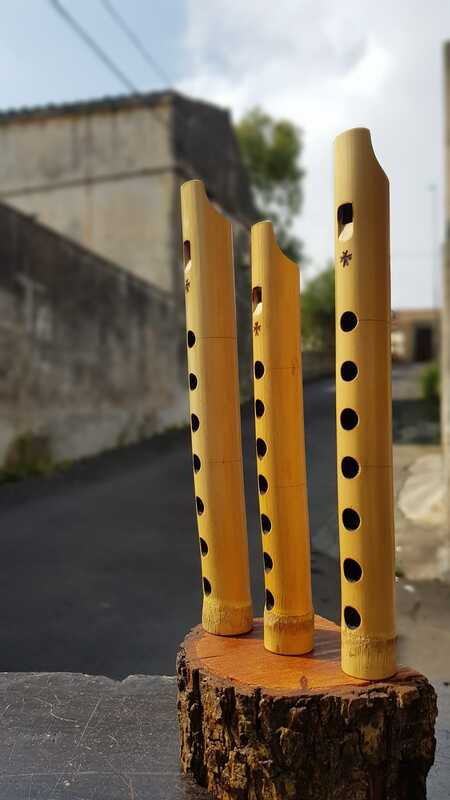
In Egypt, for example, mourners often wore their breasts exposed to symbolize rebirth, as the breast was associated with breast milk and, therefore, life. Over the centuries, these dances lost their true meaning and thus merged with the medieval tradition of the “danse macabre,” depicted in many churches, some cemeteries, and the “wild hunt” of witches. The protagonist is Death, who, playing the flute, carries away the dead, an image later interpreted as a symbol of the Black Lady’s democratic nature.
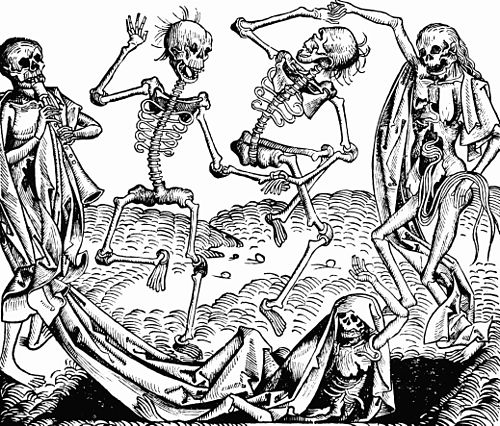
In reality, Death replaces the flutist who, in pagan tradition, it led the funeral procession and accompanied the so-called “mischievous dance” around the god’s coffin in an endless circle. Contrary to what one might think, this was neither a mournful nor demonic dance, but rather a metaphor for gaiety and vitality. Groups of people shouted, celebrated, leaped, and displayed their nakedness, roaming the countryside led by priests masked with the god’s totem animal, bringers of abundance to key places and moments of the agricultural and liturgical calendar. It was with the advent of Christianity that these “playful rambles” transformed into demonic encounters, and by transfiguring their images and meanings, fertility rituals came to be associated exclusively with the orgiastic and the diabolical, later becoming a “wild hunt.”
This fertility procession, which has become satanic and known throughout Europe as wutischen heer, mesnie furiose, mesnie hellequin, exercitus antuquus, and in Italy as societas, familia, cazza selvarega, cascia selvadega, caccia del diavolo, or cascia morta, characterizes Italian folklore from the Maritime Alps to the Julian Alps. It no longer speaks of festive figures, but rather of sinister shadows, hordes of fairies, hellish dogs with burning eyes, witches, and demons led by a mysterious and arcane figure. Nevertheless, its ancient origins remained, and so some traditions hold that the procession followed the devil’s coffin, carried by rabid dogs and lit by black candles. It was the memory of the funeral procession of the dying god, a joyous fertility rite whose screams and displays of joy turned into horrific, infernal groans, a demonization of the House of Peter.”
Romanazzi, Andrea. La Stregoneria in Italia: scongiuri, amuleti e riti della tradizione (Italian Edition) (p. 103). xx. Kindle Edition.
Ancient Dance & Music Rituals Through the Ages
Arlecchino/Harlequin of the Commedia dell’arte preserved the “wild man”, a descendant of both Hercules and Dionysus.
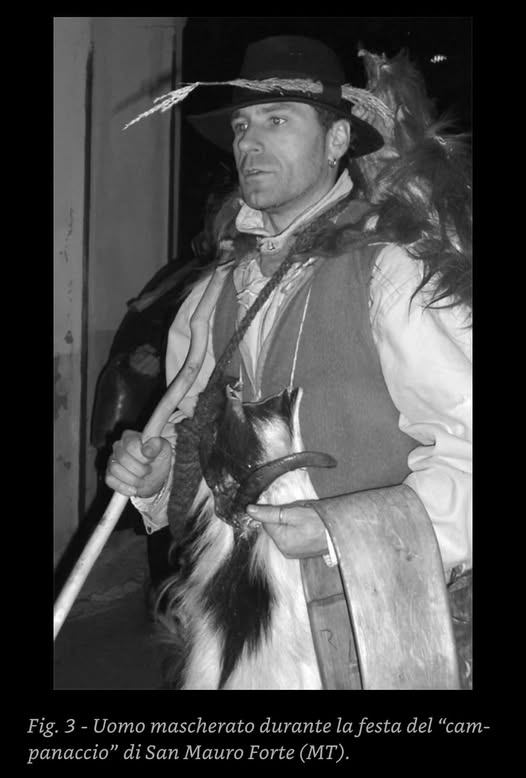
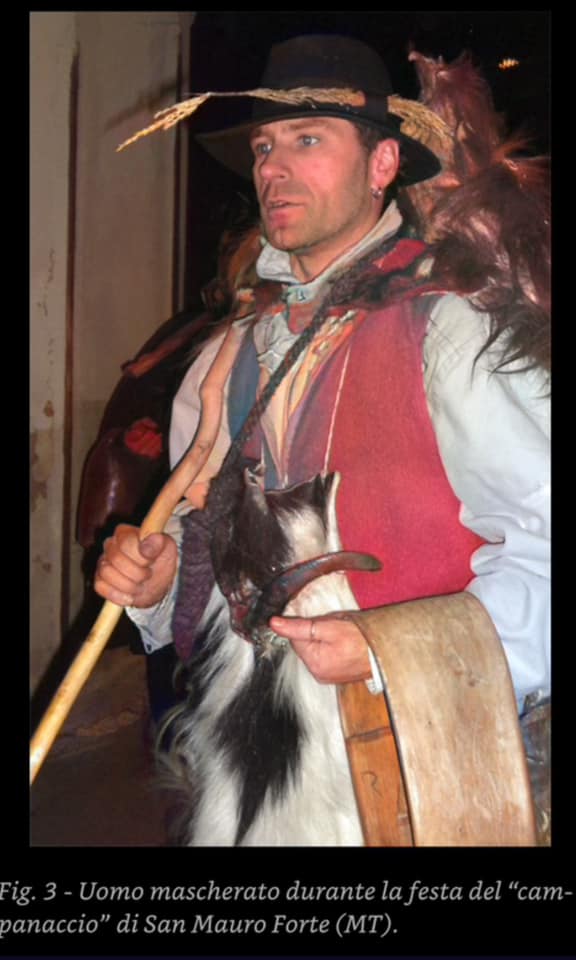
During the time of the infamous Witches Sabbaths of the tree of Benevento, it was common to be led in procession by the Devil himself. This was nothing more than ancient agricultural Pagan gatherings where the man dressed as the totemic animal of the goat would take on the identity of the “wild man”.
He would lead participants in ecstatic dances around the tree as the tree represented the meeting place of ancestors and spirits of the Earth. Flutists played music, as it was a customary instrument in funerals and black candles were brought as it represented the dead ancestors. In a wild orgiastic rite people would gather in musical dancing with nature and the ancestors believed to have portals in water also.
“L’uomo selvaggio è sicuramente una prima trasposizione antropomorfa dello spirito vegetazionale, come evidenzia anche la sua capacità di trasformarsi in animale. Se dunque nella cultura pagana egli aveva notevoli valenze positive, come quella legata al garantire la fertilità, successivamente e con l’avvento del cristianesimo venne demonizzato. La Chiesa trasformò Herlechinus in un essere diabolico che apriva il corteo delle streghe e dei demoni durante i Sabba, ed è da qui che deriva uno dei più famosi simboli del carnevale italiano: Arlecchino o Hallequin, colui che guida la processione dei dannati, la cui etimologia deriverebbe da Holle, antica divinità pagana germanica.”
Pg. 105
— La Stregoneria in Italia: scongiuri, amuleti e riti della tradizione by Andrea Romanazzi
 Salvatore Guglielmo