A February rite dedicated to the power of Mamma Schiavona and La Tammurriata
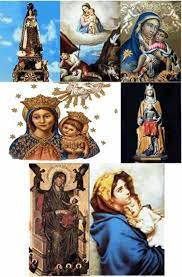
Candelora, or Candlemas, is a significant festival celebrated on February 2nd in Italy, marking the presentation of Jesus at the temple and the end of the Christmas season. This day is closely associated with various rituals and traditions, particularly in southern Italy, where it intertwines with local folklore and devotion.
Candelora and Its Similarities to American Groundhog Day
Candelora, celebrated on February 2nd, shares intriguing similarities with the well-known tradition of Groundhog Day, particularly in its connection to weather patterns and agricultural predictions. In Italy, this festival marks the presentation of Jesus at the temple but is also steeped in local folklore that highlights the importance of the changing seasons and the community’s relationship with nature.
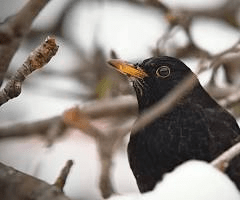
In various regions of Italy, Candelora is characterized by the belief that the weather on this day can predict what lies ahead for the coming months. Folklore suggests that if the sun shines on Candelora, or if it is a clear day, there is still much winter to come. Conversely, if the skies are overcast and it rains, spring will arrive early. This weather lore associates with the traditions of the blackbird, a bird that plays a pivotal role in many Italian communities. The Giorni della Merla (Days of the Blackbird) are the last three days of January (29th, 30th, 31st) in Italy, traditionally considered the coldest of the year. Legend dictates that a white blackbird and her chicks turned black while hiding in a chimney during this, forecasting a long winter if cold, or early spring if mild.
Key Details of the Tradition. According to popular lore, blackbirds were once white. To escape a particularly freezing January, a blackbird hid in a chimney for three days, emerging black from the soot on February 1st.
Migratory patterns of birds, particularly the blackbird, have long been a natural indicator for farmers regarding the onset of spring. According to traditional beliefs, the behavior of blackbirds around Candelora can be observed to offer clues about the weather. For example, if blackbirds are seen or heard chirping merrily, it may suggest milder temperatures ahead, while their absence or more subdued behavior could indicate continued cold weather. This connection stems from a deep-rooted understanding of the natural world, where both the arrival of certain birds and specific weather patterns serve as signs for agricultural planning and readiness for the planting season.
Similar to the celebrations surrounding Groundhog Day in the United States, where a groundhog’s emergence from its burrow is interpreted as a harbinger of spring or prolonged winter, Candelora’s customs display a communal awareness of nature’s cycles. Both traditions reflect a blend of religious significance and practical concerns about the agricultural calendar.
Across Italy, Candelora is not only a time to honor the sacred but also serves as a reminder to farmers and rural communities to pay close attention to signs from the environment. This interplay between spirituality and nature finds common ground with Groundhog Day, as both holidays commemorate the transition from winter into spring while integrating local animal symbolism and folklore traditions. Ultimately, Candelora stands as a vibrant testament to the rich tapestry of Italian culture, intertwining faith, community, and the rhythmic patterns of the changing seasons.
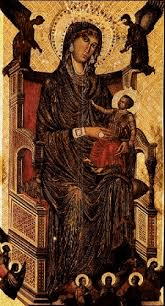
In Montevergine, a region revered for its sacred mountain and the sanctuary of Mamma Schiavona, Candelora takes on a profound cultural and spiritual significance. Mamma Schiavona, epitomizing maternal care and protection, is a popular figure whose veneration draws countless pilgrims seeking her intercession. During Candelora, followers honor her through various customs that reflect the blend of Christian and local traditions.
One of the most vibrant expressions of this celebration is La Tammurriata, a traditional dance and music form rooted in the region’s folk culture. Tammurriata, characterized by its lively 4/4 rhythms and communal participation, serves as an artistic and spiritual tribute to Mamma Schiavona., the serving or slave mother. The dance often commemorates the agricultural cycle and the impending arrival of spring, reinforcing the connection between the earth’s fertility and the divine protection of the Mother figure.
Integral to this festival is the Legend of the Seven Sisters, a tale rich with symbolism and teaching. According to local lore, there were six sister Mary’s who were very vain and obsessed with their beauty, constantly gazing upon themselves in mirrors. When they saw Mamma Schiavona, they saw her dark complexion and called her ugly, as they all had fair features. They cast her to Monte Vergine where she lived in solitutude, never to be seen again. Until one day, two men that were lovers were also cast out of the nearby town Avellino. Tied to a an oak tree and left to die in the cold, a strange bright light shined upon them and their bondage mysteriously loosened. Freed, they ran to this mountain where this mysterious light shined from. There they saw the beauty and divine light from Mamma Schiavona and honored her for delivering them from death. When the villages realized these men had escaped, they went after them in a riot. Upon finding them on the mountain, they stopped in awe of the power and beauty of Mamma Schiavona. She spoke and declared these men her sacred children, the Femminilli.
During the festivities, processions are held, filled with the light of candles reflecting the devotion of the community. Participants dance to the captivating rhythms of the tammurriata, celebrating not only the feast day but also the enduring legacy and protection offered by Mamma Schiavona and her sisters. This confluence of dance, music, and spirituality marks Candelora as a vital celebration of cultural identity and collective memory in Italy, particularly in the shadow of Montevergine.
Each of the seven Madonna’s has their own Tammurriata as there are seven variations. These dances evolved from temple dancing in ancient times, influenced for millennia from civilizations such as the Roman, Greek, Egyptian, Etruscan, Phoenician, etc. On Montevergine, the temple once stood of the goddess Cybele who’s priests were castrated men known as Galli. This goddess was prophesized as the savior of Rome by the Cumean Sybil who also prophesized the birth of Christ with the Mago Poeto, Virgil. Today the cathedral of Mamma Schiavona sits atop where the temple once stood, a living testiment of the continuity between ancient culture and modern. The other six sisters are Madonna’s who have absorbed attirubutes from their ancient counterparts such as the goddesses Venus, Hecate, Diana, etc.
The 7 Madonna’s or the Sette Sorelle
- La Madonna dell’Arco di Sant’Anastasia (Napoli)
- La Madonna Pacchiana di Castello di Somma Vesuviana (Napoli)
- La Madonna delle Galline di Pagani (Salerno)
- La Madonna dei Bagni di Scafati (Salerno)
- La Madonna dell’Avvocata di Maiori (Salerno)
- La Madonna di Materdomini di Nocera Superiore (Salerno)
- La Madonna di Montevergine (Avellino)
The Sette Sorelle Legend of Tammurriata and the Pleiades Myth: A Comparative Exploration
The legend of the Sette Sorelle, or “Seven Sisters,” within the context of the Tammurriata tradition in Italy, shares fascinating parallels with the Pleiades myth found in various cultures around the world. Both narratives illustrate the enduring themes of sisterhood, celestial connections, and the intertwining of nature and mythology.
The Sette Sorelle in Italian Folklore
In the tradition surrounding Mamma Schiavona and the Tammurriata dance, the legend of the Sette Sorelle tells the story of six vain sisters who neglect the beauty of Mamma Schiavona, leading to her isolation on Montevergine. These sisters, obsessed with their own reflections, represent human vanity and the consequences of superficiality. The narrative culminates in Mamma Schiavona’s miraculous intervention, showcasing her divine beauty and power, which ultimately wins over those who initially scorned her.
During Candelora, the Tammurriata dances reveal the rich cultural tapestry of southern Italy, linking the earthly and the divine through rhythmic movements and communal participation. The symbolic journey of the sisters from vanity to reverence mirrors the deeper spiritual quest inherent in the celebration.
The Pleiades Myth Across Cultures
Similarly, the Pleiades star cluster—often referred to as the Seven Sisters—has been a source of inspiration and storytelling across various cultures, including Greek, Native American, and Australian Aboriginal traditions. In Greek mythology, the Pleiades were the seven daughters of Atlas and represented a connection to navigation and agriculture. Their rising in the spring heralded the planting season, much like the Tammurriata dances signal the arrival of spring in Italy.
In Native American myths, the Pleiades are often depicted as a group of sisters who embody different attributes and serve vital roles within their respective communities. From establishing the seasons to guiding travelers, their stories underscore the interconnectedness of celestial bodies and earthly life.
Common Themes and Connections
Both the Sette Sorelle and Pleiades myths highlight several key themes:
- Matriarchy: At the core of both legends lies the notion of matriarchy, with each sister representing unique qualities and collective identities. This unity offers strength and support within communities.
- Vanity and Redemption: The tale of the Sette Sorelle emphasizes the dangers of vanity, while the Pleiades myths often celebrate the virtues of humility and service, showcasing the transformation of the sisters into symbols of guidance and protection.
- Celestial and Terrestrial Connections: Both narratives link earthly experiences to celestial phenomena. Just as the Sette Sorelle are integral to the Tammurriata’s cultural significance, the Pleiades are seen as guiding lights in the night sky, influencing agricultural practices and seasonal changes.
- Cultural Resilience: The enduring nature of these myths reflects how societies utilize storytelling to navigate the complexities of life, identity, and the natural world. They serve as vessels for collective memory, fostering community cohesion through shared cultural practices.
SO what is Tammurriata exactly?
Tammurriata is steeped in oral folklore and mythic origins. In the end, we really don’t know how it started! But we do have oral tradition and theories such as temple dancing and origins with women sowing seeds in the field beneath the moon. These rhythmic songs and dances of the the sowing of the grain may have become the first movements of Tammurriata. It is ultimately a form of Tarantella that developed a distinct form in Campania. Intimately connected to La Madonna and in particular, Madonna’s with strong ties to ancient goddesses, especially those we collectively call Black Madonna’s.
Tammurriata transcends mere dance and musical expression; it embodies a profound philosophy and spiritual practice rooted in community, communion with the divine, and the reflection of the soul, ultimately seeking alignment with natural forces. This art form serves as a conduit for inviting the divine within, facilitating necessary balances and liberating both mind and body. Historically, during the Middle Ages, it exerted a notable influence on the Dance Macabre movement in art and was often regarded with trepidation as a manifestation of witchcraft by the Holy Roman Office. Yet, akin to its role in contemporary society, it endowed individuals with a renewed sense of personal empowerment and freedom. Within this context, the divine is not perceived as an external entity; rather, it is summoned and realized internally. Tammurriata operates as both a prayer and an invocation, a route to internal gnosis, where wisdom granted by the divinity embedded in nature can be genuinely integrated and comprehended.
If you’re interested in learning more about this tradition, come join me and Anna Harsh of Allegro Dance Company on Sunday, February 1st on Zoom!
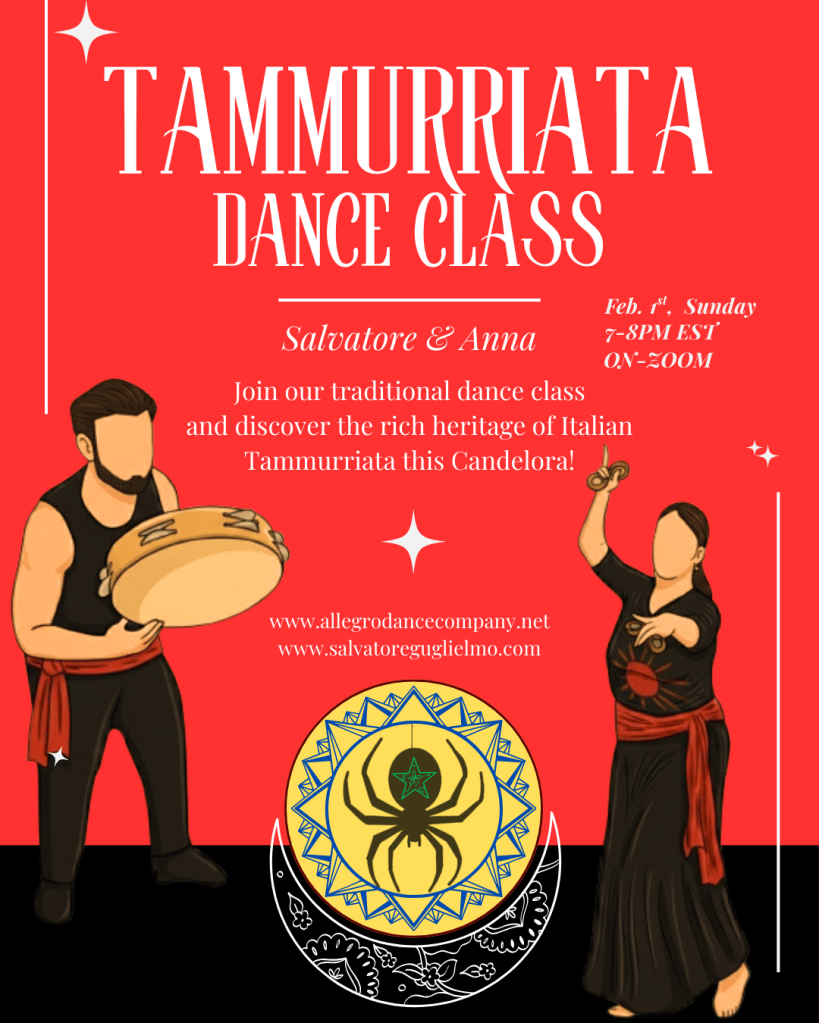
Candelora Tammurriata Dancing for Mamma Schiavona
Start/End Date: Feb. 1st, Sunday 7PM – 8PM EST
Location: Zoom
Donation Based

On-going Classes Always
$60/1hr Private + Zoom Recording
$45/1hr Group + Zoom Recording (2 people minimum)

Designed with WordPress
 Salvatore Guglielmo