Holy Rain Maker of the Equinox
Mar 02, 2026
“The third month of the year was dedicated by the Roman Empire to Mars, the god of war. This may show the military genius the power of con-quest, the tribute to the war god through whom came Roman power and territorial expansion. In the Christian calendar this month is consecrated to St. Joseph, our great captain in the spiritual warfare of life.”
– Annals of Saint Joseph. (1917). United States: Norbertine Fathers.
Attributes and veneration
Candle Color: Yellow
Foods: Fava beans, zeppole, bread, wine
Plants/Scents: Lilies, spikenard
Songs/Hymns: Various, Rosario di San Giuseppe
Feast Day: March 19th
Attributes: Carpenter’s square or tools, holding the infant Jesus Christ, staff with lily blossoms, two turtle doves, and a rod of spikenard, Catholic Church, fathers, workers, carpenters, married people, persons living in exile, the sick and dying, for a happy death
The 3 Tiered Altar
March 19th marks this most special time of year when families, especially Sicilian, create a 3 tiered altar in honor of Saint Joseph. His favorite foods are placed there which include bread, maccu (fava bean puree), and zeppole (pastry) among many other recipes. Lilies can also be found on his altar with a statue of him on top.
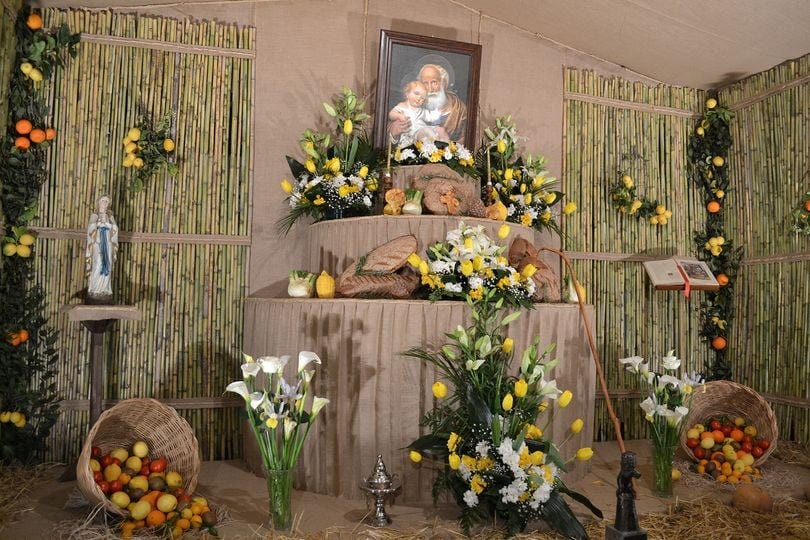
Here is a beautiful rosary devotion for him captured from U Luppinaru
Rosario in siciliano a San Giuseppe
“San Giusippuzzu fustivu patri
fustivu virgini comu la matri
Maria la rosa Giuseppi lu gigghiu
datini aiutu di pani e cunsigghiu
e a la fini di la morti me
lu nomu di Gesù, Giuseppi e Marè.”
Traduzione:
“San Giuseppe foste padre
foste vergine come la madre
Maria la rosa Giuseppe il giglio
dateci aiuto di pane e consiglio
e alla fine della morte mia
il nome di Gesù, Giuseppe e Maria.”
Grani
“San Giusippuzzu nun m’abbannunati
nta li bisogni e nicissitati.
Binidittu e ludatu sia
lu nomu di Gesu, Giuseppi e Marè.”
Traduzione:
“San Giuseppe non abbandonatemi
nei bisogni e nelle necessità.
Benedetto e lodato sia
il nome di Gesù, Giuseppe e Maria.”
Salve Regina del Rosario a San Giuseppe
Diu vi salvi Giuseppi
cu Cristu e cu Maria,
sta bedda cumpagnia
da Diu fu data.
A tia fu cunsignata
Maria la virginedda,
sta spusa tutta bedda
a tia tuccau.
Lu Diu ca s’incarnau
pi patri a tia eleggiu
pi sempri t’obbediu
cu gran rispettu.
E dunqui fusti elettu
pi Diu essiri santu
tu sì lu miu avvocatu
e protetturi.
E dunqui sti primuri
l’accettu cu piaceri
nun haiu chi timìri
in vita e morti.
In vita avrò la sorti
arricurrennu a tia
sarà cuncessu a mia
ogni favori.
In morti avrò l’unuri
di aviriti in mia assistenza
e poi godiri cuntentu
in Paradisu.
Godìri lu to visu
Giuseppi cu Maria
cu Gesu in cumpagnia
eternamenti.
Ludatu sempri sia
lu nomu di Gesuzzu
di Giuseppi e di Maria.
Traduzione:
Dio vi salvi Giuseppe
con Cristo e con Maria
questa bella compagnia
da Dio fu data.
A te fu consegnata
Maria la verginella
questa sposa tutta bella
a te toccò.
Il Dio che s’incarnò
per padre ti elesse santo
per sempre ti obbedì
con gran rispetto.
E dunque fosti eletto
per Dio essere santo
tu sei il mio avvocato
e protettore.
E dunque queste premure
le accetto con piacere
non ho cosa temere
in vita e in morte.
In vita avrò la sorte
ricorrendo a te
mi sarà concesso
ogni favore.
In morte avrò l’onore
di averti in mia assistenza
e poi godere contento
in Paradiso.
Godere il tuo viso
Giuseppe con Maria
con Gesù in compagnia
eternamente.
Lodato sempre sia
il nome di Gesù
di Giuseppe e di Maria.
(Tratto da: “A Cruna. Antologia di Rosari Siciliani”, di Sara Favarò. Ed. Città Aperta e da Benedicaria)
Curated San Giuseppe videos
Traditions, Dance, Drumming, Folklore and Magic
Vampa (bonfires) are lit marking the spring Equinox for Saint Joseph. People sometimes run around in a type of round dance while drummers beat the very typical festival rhythm sacred to many divinities. However, Saint Joseph is more than just a Saint, he is the spiritual father of the Sicilian people.
He is the great carpenter of heaven, a holy rainmaker, a paternal spirit of green Earth, and lord of the fava bean. During the great fava bean famine during the middle ages, he was invoked to bring Sicily rain and make crops grow. In oral tradition, when he originally failed to perform this operational request, Sicilians resorted to more ancient sorcery, they punished the Saint through the burning heat of the drought. His statue was placed in the burnt field and was told, “as we burn, you shall burn for as long as you do not bring rain”. [Part of this can be found in the book Madonnas that Maim]
In this regard, he is a spirit of rain, springs, and fertility of the land. Taking over the role over the original function of Mars as lord of crops. After the rains came, the people rejoiced and the the only food that grew after the rain was the fava, the lucky bean, bean of the dead.
Home selling ritual
A very common ritual of Saint Joseph is for selling your home. For this ritual, you will need a statue of Saint Joseph, wine, bread, and a shovel. On the property, dig a hole and place a statue of Saint Joseph upside down. Fill the hole with wine and bread as an offering with prayers and any special requests. When the home sells, you must exhume him from the ground and set up a 3-tiered altar to him in your new home. This ritual is intended not only to sell your home, but to bring abundance into your new abode.

Why are these practices important for us today?
San Giuseppe is more than just a Saint. He is a spiritual father, a nurturer, a provider, a protector of the home, a representative of how every husband and father should be. He is the attainable masculine force that sustains the home, family, home, and productive labor. We must always look beyond the deific mask and see the symbol, embrace it, step into it.
The Silent Pillar
While other figures in Catholicism are defined by their words or miracles, San Giuseppe is defined by his presence. He represents the “Sacred Ordinary”, the architect of life. He reminds us that the most profound spiritual work often happens in the sawdust of a workshop or the quiet vigilance of watchfulness. To step into his symbol is to accept that greatness is not found in being served, but in being the foundation upon serving others.
The Alchemy of Labor
He transforms productive labor from a burden into an act of worship. In the hands of a protector, a tool is not just a means to an end, it forms an extension of will to provide. He bridges the gap between the divine and the earthly, proving that:
- Strength is found in love and patience in the workshop and family.
- Authority is earned through service and empathy.
- Leadership is the courage to remain steadfast when the path is uncertain.
Beyond the Icon
To step into the symbol of San Giuseppe is to practice a mastery of the ego. He stands in the shadow of the Divine, yet he is the one who taught the Divine how to walk, how to work, and how to be a man. He is the blueprint for the “Protective Masculine”—the force that creates a perimeter of safety so that life can flourish within it. He is the quiet heartbeat of the home, the unseen, yet the very reason hearth of the home burns eternally.
 Salvatore Guglielmo